
Serving Northern St. Louis County, Minnesota
A case for saving our National Parks
Posted 1/8/26
In 1974, a brave young woman, born and raised on the edge of urban Detroit, always dreamed of a different life. Her world wasn’t bad. She tried university but decided that an academic education …
This item is available in full to subscribers.
Attention subscribers
To continue reading, you will need to either log in to your subscriber account, below, or purchase a new subscription.
Please log in to continue |
A case for saving our National Parks
Posted
In 1974, a brave young woman, born and raised on the edge of urban Detroit, always dreamed of a different life. Her world wasn’t bad. She tried university but decided that an academic education wasn’t her cup of tea. She worked in factories, none of them unionized, handling a variety of products. She ran machines that bound books, boxed pottery, and one summer, lifted semi-truck battery cases and muffler parts from huge vats of boiling hot chrome. The working conditions were atrocious. After a couple of years, she knew she was done with that. When she landed a job at a large Catholic hospital, she thought her ship had come in. The wages were higher and the conditions far better than barely tolerable. But she continued to develop her escape plan. She would work until she’d bought a car and saved $2,000. Then she’d give notice, let go of her sweet little efficiency, load up her meagre possessions and her faithful hound, Manfred, and hit the road.
As she was about to put the ‘burbs behind her, she veered off I-75 to stop and share some reassurance and final goodbyes with her parents. She recalled their initial reaction weeks back about her decision to move out west and seek a “different life.” As expected, they couldn’t muster even a sliver of enthusiasm for her plan. Instead, they reiterated the risks and potential disasters, topped off with downright disapproval.
Their shocked expressions with her unannounced arrival should have been a clear warning. But by then, it was too late to do anything but cross their threshold and enter their house. She was glad she’d left Manfred in the car. He’d be the reason for a quick exit if the atmosphere became too hot.
“Hi. … I really can’t stay long,” she began, impulsively adding, “I’m on my way to Tucson.”
“Tucson!” her mother spat out. She watched as her mom worked hard to suppress any sign of her upset or the rage that Kate couldn’t bear to witness again.
“I just wanted to drop in to say goodbye,” Kate went on.
The pair just stared. The man who had tried so hard to be her dad said, “Oh.” And that was all. Just a flat “Oh.”
Kate leaned in toward her mother, extending her arms for a hug. Her mother coiled with a barely audible utterance. “We’ll miss you,” she said and then pulled away.
Kate nodded her goodbye and turned to leave. With a surge of relief, she strode up the hill, got into the car and put it in reverse. Manfred started to bark. There was Kate’s mother rushing after her, arms waving to get her attention.
“Please wait,” she hollered, lifting up her Polaroid. “Kate, I need to take your picture!” Kate put the car into park and got out. Her mother snapped two. Just like the sales ads had promised, the camera with the “built-in dark room” had captured their moment, opening the door to a final embrace.
“I stayed too long,” Kate thought as she slowly merged into the throes of rush-hour traffic. Once on the road, she was heading for the adventure she could never have imagined.
In planning, Kate purchased a Rand McNally “Road Atlas of America.” Having never ventured farther from Detroit than Sandusky, Ohio, she was stunned by the vast empty territory pictured on those maps between her home and her sister’s in Tucson, Ariz., thinking that would act as a good home base from which to begin her journey of a lifetime.
Through that summer of 1974, Kate and Manfred traveled a route of mostly two-lane highways through some of the most scenic regions of eight western states, camping and hiking their way north from Tucson to Spokane, Wash., “the smallest city ever to host a World’s Fair.” After experiencing exhibits from all over the world, they left Expo ’74 behind and headed west toward the Pacific Coast. Destination? Washington’s renowned Olympic Peninsula, a lush coastal rainforest unmatched in the Lower 48.
From the Olympic National Park, Kate headed down the Pacific Coast with its magnificent vistas and perfect stops along the way for pitching a tent. She eventually landed in Los Angeles. Thanks to a chance meeting with a hitchhiker around Big Sur, she lodged with his family and spent a wild and crazy day at Disneyland. Leaving the amazing LA ocean metropolis and a new friend behind, she and her dog drove east, traveling through mountain passes until picking up Interstate 10 at Palm Springs.
The Mojave Desert encompasses much of Southern California before it eventually spills into Arizona’s gorgeously green Sonora Desert. It’s known for its wide variety of cactus, including the long-lived and stately Saguaro, many measuring 50 to 60 feet tall. The region is so stunning that it became a national park named after its defining feature, the Saguaro.
By the time Kate arrived back to Tucson, her camera bag was filled with rolls of 35mm film containers waiting to be developed. Her journal was bursting with unforgettable stories, names of places and people that she’d recall for years to come. Most notable were entries describing the breathtaking beauty of our national parks, specifically set aside for anyone curious enough to visit.
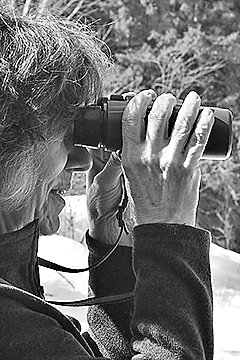
Kate’s story is actually my story. With 50 years of separation, while scanning old photos and recalling a host of vivid characters, I felt like a river current had swept me up and delivered a travelogue oddly in the “third person”. It was in that tense that the story flowed.
One might ask why this tale even matters. Here’s why. In today’s world, the fate of our public lands is in the crosshairs of people who may never have set foot in a national park, and consequently, missed the awe and wonder of nature’s most exquisite formations. They might look at a mountainside or a stand of virgin redwoods and see nothing but dollar signs. This is why I was so moved to share my story.
Today, we’re witnessing a full-court assault, exerted by some extreme right-wing political and financial influencers, on current government policies that protect our precious public lands. Many very popular laws designed to preserve our National Parks are now being reversed. With Trump’s executive orders, economic and industrial interests can’t wait to extract presently untapped resources that exist within these protected boundaries. Mining and drilling companies as well as billion-dollar investment firms are lining up for permits to begin their “development” schemes, many that are projected to result in irreversible damage to these iconic national treasures.
We’re told that “deregulation” is necessary for the good of our country when, in fact, scientific evidence shows quite the opposite. A high-stakes simplified debate pits economic growth and “jobs” against the “environment.” And the major players are pushing the “jobs” card hard.
A big question that hangs above the balance is how much power the president will wield with his signature king-sized Sharpie signing executive orders at breakneck speed. He seems to have taken a position that the constitutionally protected role of Congress, to make laws and remove them when necessary, be damned.
Do others remember Shakespeare’s Marcellus’ famous line in “Hamlet?”
“Something is rotten in the state of Denmark.” If this is an apt description for the current state of U.S. federal affairs, what should we be doing to prevent permanent damage to our public lands? If we agree that the despoiling of these extraordinary and truly sacred sites, places like the Grand Canyon, Mesa Verde, Yellowstone, or the mystical Olympic Peninsula, just to name a few of the equally awesome 63 designated U.S. National Parks, is unacceptable, than what can we do to assure their existence for our children and generations beyond?
A recent article in the winter edition of the National Parks Conservation Association Magazine, advises us to “visit, visit, visit.” This action substantiates that those of us actively defending our parks do so based on our direct experience of their intrinsic value. And there are many millions of us strong! We’re also being asked to call or send an email to our representatives in Congress telling them to perform their rightful duty to write and defend laws that safeguard park preservation in the face of this looming assault by corporate interests who want only to capitalize on them.
Major steps in their effort to exploit their resources have already begun with the full support of Trump and his cabinet. After watching the negative impacts of his first year in office, imagine what bodes for the parks in three remaining years of his term. To paraphrase environmental activist Helen Caldicott, if we love this country we must act now.
So, let’s get started. Whad’ya say we all meet in Voyageur’s National Park this summer for a scenic hike and a picnic? And oh, for snowmobilers, the trails are waiting, so beat us there. And in the meantime, let’s do our phone calls and emails. Don’t wait. Do them now. And I’ll plan to see you this summer!


