
Dedication held for new DNR office at Nett Lake
NETT LAKE— The Bois Forte Band held a dedication ceremony last week for a project years in the making – a new Department of Natural Resources building that will serve not just as an …
This item is available in full to subscribers.
Attention subscribers
To continue reading, you will need to either log in to your subscriber account, below, or purchase a new subscription.
Please log in to continue |
Dedication held for new DNR office at Nett Lake

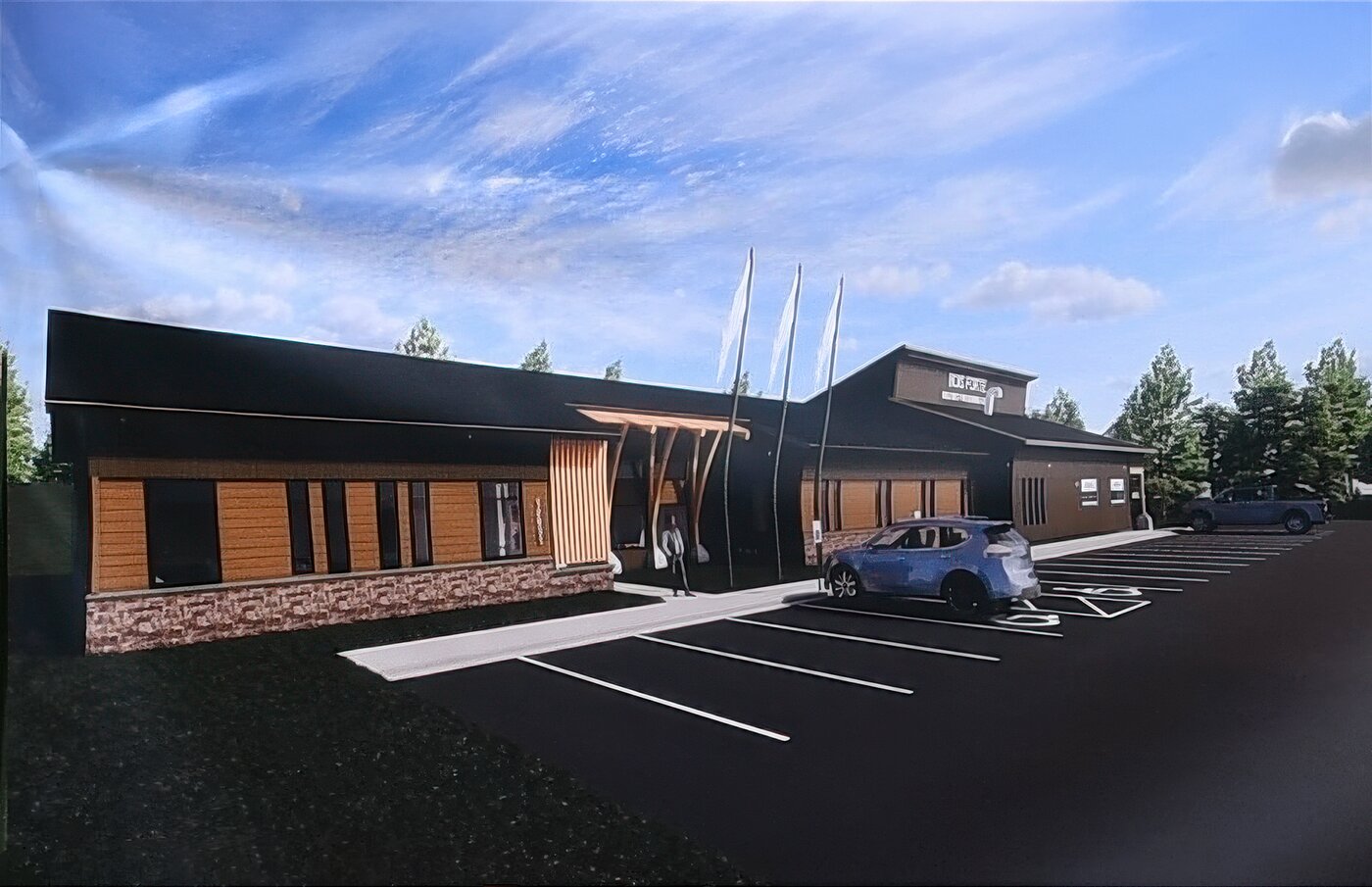


NETT LAKE— The Bois Forte Band held a dedication ceremony last week for a project years in the making – a new Department of Natural Resources building that will serve not just as an administrative center, but as a space for the community and a state-of-the-art facility for storing and processing the Band’s sacred wild rice harvest.
The 7,000-square-foot building, now rising in a small clearing in the woods not far from the Band’s public works facility, represents far more than upgraded office space– it’s a project nestled within the very natural landscape the department is charged with protecting. That was clear from the words shared Thursday during a small but meaningful dedication ceremony led by tribal leaders, architects, and DNR staff.
“It is a great honor to stand with you today as we break ground on a building that represents much more than bricks and dreams,” said Tribal Chair Carlos Hernandez as he opened the event. “This building will not only support their work, it will strengthen our sovereignty. It will allow us to operate with more capacity, more dignity, and more opportunity to teach and to lead in conservation and restoration.”
For Hernandez, one of the most important elements of the new facility is what it will offer for the Band’s wild rice program.
“Manoomin is not just food. It is a gift from the Creator,” he said. “It connects us to our ancestors, to our seasonal rhythms, and to the sacred responsibility we hold as caretakers of the land and water. With proper storage and care, we honor that gift and ensure it remains strong for our children and grandchildren.”
No one brought more heart to the moment than Natural Resources Director Chris Holm, whose nearly 30-year history with the DNR department has been spent working out of the old administration building, affectionately and appropriately called “the barn.”
“All my working life here, for decades, I’ve lived in the old Natural Resources administration building,” Holm said. “I often call it the barn. Natural Resources administration building as an acronym is NRAB. If you spell that backwards, it spells barn.”
Holm admitted he had some initial hesitation about the idea of a new building.
“I was appreciative and happy, but inside I was like, kind of sad, right?” he said. “It was a little hard for me to let go of that.”
But as the design process unfolded, and as the needs of the department and community grew clearer, that hesitation gave way to enthusiasm.
“By the end of it, I’m jumping right in there,” he said. “So, I was excited and I think that was the turning point for me and I’m glad that we are doing this.”
The new building will provide both form and function. On the west side of the structure, Holm said, “is 564 square feet of community meeting space.” He called that space “a major welcome addition that we hope is going to be used a lot in the future by the community.”
But it’s the east side of the building that may hold the most cultural and environmental significance.
“On the east side is a 1,390 square foot rice inventory, storage, and processing room,” Holm said. “It will be humidity, climate, temperature controlled to the optimum levels to support rice that is processed and finished.”
Those upgrades stand to transform how the Band manages, stores, and preserves its wild rice, a crop that is not only central to Anishinaabe lifeways but also to sovereignty and identity.
Architect Eric Wedge, of DSGW Architecture, reflected on that heritage in his remarks.
“We are gathered here on your ancestral land,” he said. “Today we break ground on a facility that represents more than just a building.”
Wedge said his team worked closely with tribal members to ensure the design honored both functionality and traditional values.
“This facility needed to be more than just functional. It needed to reflect the values, respect the landscape, embody the principles of sustainability,” he said. “This facility will become an environmental responsibility, a place of learning, a testament of resilience, and a vision of the Bois Forte Band.”
The building’s design is rooted in feedback from tribal departments and driven by a collaboration that Holm praised repeatedly in his remarks. He spoke with admiration about the grant writing, planning, and design teams that brought the vision to life, and gave thanks for the support received from the Bois Forte Tribal Council, DSGW, and contractor Valint Construction Services.
“I’m very impressed, very astounded at the amount of teamwork and expertise and knowledge that goes into this sort of choreographed dance of building a building from nothing,” Holm said.
The project was made possible by a highly competitive $2 million grant from the Indian Community Development Block Grant (ICDBG) program through the Department of Housing and Urban Development. Dave Danz, the Band’s longtime grant writer, explained just how rare that funding was.
“This grant was a $2 million grant,” he said. “It was the biggest grant that Indian Community Development block grant had ever put out up to that time.”
While not all the 550 federally recognized tribes in the U.S. submitted applications, Danz noted, receiving the award was a big achievement.
“The number of grants that they give out is probably a dozen,” he said.
Work on the site is now underway. Holm said the spot was chosen because of its elevation and dryness, but those features also meant construction teams had to dig through rock. Still, he said, “That didn’t really set anything back.”
The project is slated to be complete by spring 2026. Hernandez encapsulated its significance in his remarks.
“This is more than a structure,” he said. “It is a home for our mission and a tool for our future. Miigwech to our staff, our council, and everyone who helped move this forward. We are building not just for today, but for the next seven generations.”


